José Roberto Aguilar — Dream and Counter-Dream: Interview with filmmaker and artist Gregório Gananian on his relationship with José Roberto Aguilar
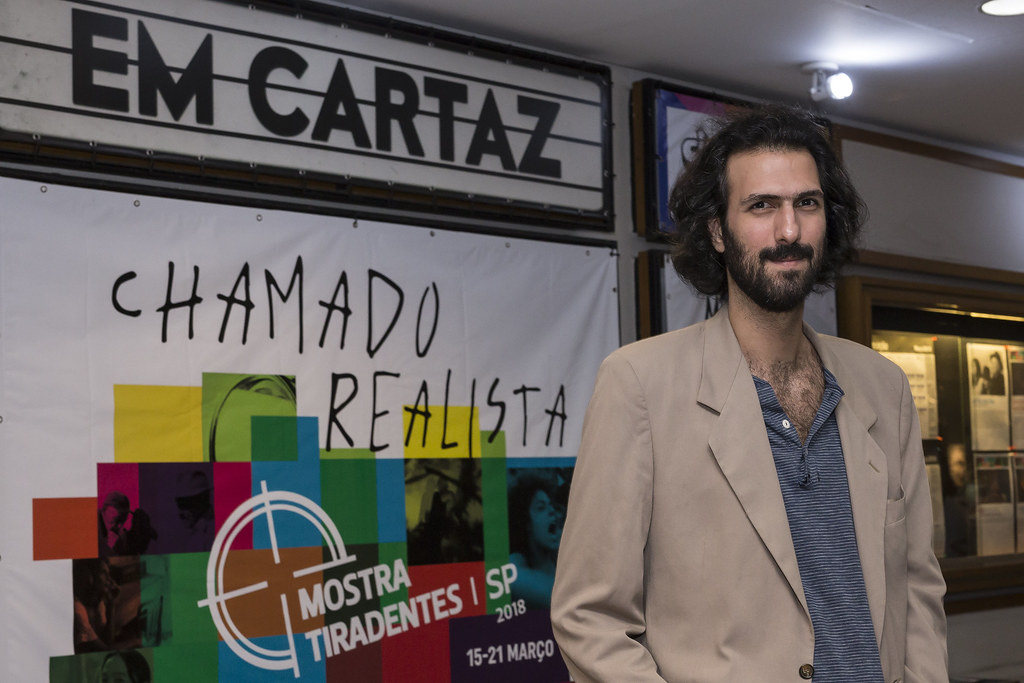
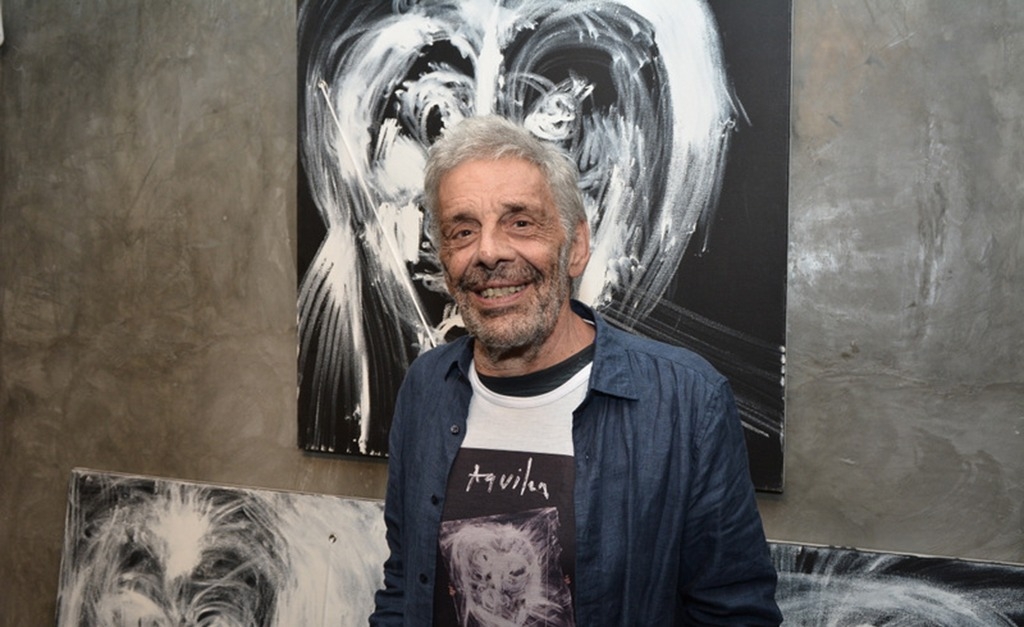
The interview with Gregório Gananian, filmmaker and curator/director of the exhibition José Roberto Aguilar — Sonho e Contrassonho (Dream and Counter-Dream) at the MAM Cinemateca, was conducted on November 20, 2023. It covers not only the exhibition itself but also Gregório's artistic relationship with Aguilar.
How did your artistic collaboration with Aguilar come about? How did you two meet?
Well, Aguilar's name was already in the air for me because of his musical group, the _Banda Performática_, which he formed with collaborators like Lanny Gordin, Paulo Miklos, Arnaldo Antunes, Teca Berlink, and Jorge Mautner. And I remember once, years ago, watching a video on YouTube of a sung performance he did with the band, called "Os Corações" ("The Hearts"). In that performance he cut open hearts made of paint with a knife and let the paint spill over his body. It's a brilliant, wonderful performance.
And there was a day when I was at the house of a friend of mine, a wonderful poet and artist named João Reinaldo Paiva, and he asked me, "Man, do you know the texts Aguilar wrote?" And I didn't. That day he introduced me to Aguilar's books, I read _A Divina Comédia Brasileira_ (_The Brazilian Divine Comedy_) and _O Hércules Pastiche_ (_The Hercules Pastiche_), I spent the whole afternoon reading them. I discovered the characters Agripino de Paula, Getúlio Vargas 1 and Getúlio Vargas 2 — almost like a young version and an old version of Getúlio. And Artaud, and Artaud's Shoe. I was very struck by their collage quality, by the sense of humor, by the lightness and, at the same time, the very expressive radicalness of the writing — a quality that has a lot to do with Aguilar's painting itself.
What impressed me most about his books was that quality of delirium, where you could have distinct, different figures inhabiting the same page — like Artaud's Shoe inhabiting the same space as a President of the United States, you know? It's a way of making these figures part of the same synchronic sea. They communicate with each other. A human being like Aguilar, to me, is someone who manages to penetrate distinct fields, within this broad life-thought across its differences.
And the first time we worked together was while I was planning _Inaudito_ (2017), my feature film about Lanny Gordin. By then I was already following Aguilar on Facebook, and I'd occasionally post things that Aguilar would like and comment on, and around the time I was going to make the film, Lanny Gordin was playing in the _Banda Performática_ — he was a very important figure for the band, so much so that their classic album has Lanny's photo on it, and I found that very curious, because it was from around 1980, a period when Lanny didn't have many recordings out. I found that very powerful, very symbolic, since it was one of the only recordings Lanny made in that period.
So around that time I sent Aguilar a message saying, "Look, I'm going to make a film with Lanny Gordin, and we're going to shoot it in China," and he wrote back, "You're going to China? Then come to my studio right now!" And that was that. I went to Aguilar's studio, showed him my work, I remember showing him a film I'd made in Parque Augusta and he was thrilled by it. He started talking to me about the act of looking, about the eye of a first-time experience, and in that moment we had an absolute recognition, as if I'd known him for a long time already. And what I remember most is feeling that Aguilar could cross through a portal, you know? He's an artist who manages to stand on the other side of the portal. Usually people stay around it, but not him — he manages to live inside it. It was a very beautiful encounter, he opened up a side of Lanny to me that I didn't know how to put into words, I could only sense it.
And from there we started meeting regularly, we'd have lunch together, I went to his place a lot — he lives in a house in the Bixiga neighborhood in São Paulo, one of the most interesting neighborhoods in the city. And from that I invited him to take part in _Inaudito_ (2017), and there's a curious thing about the film: the artists I invited to appear in it were Aguilar, Macalé, and Negro Leo. I think I wasn't interested in calling in artists like Caetano or Gil, because the film was very much about the present-day version of Lanny, about that modern process of his. And Aguilar gives a beautiful performance in the film, he paints white over white, on a white wall. And when I went through the footage from the film afterward, he started telling me, "Let's keep making things together!" It was an invitation that came from him. And from there we established a partnership. I think by now we've made more than 30 performances together, maybe more.
We've worked together so much that I consider him family, a kind of friend-father-son. He's a great friend to me, he's always there for me. I remember we recently did a video installation at Sesc Consolação, and it turned out divine. I go to his house weekly, I sit with him and we chat. During the pandemic we'd do a livestream every week, we developed a lot of projects together, he's a figure who teaches me a great deal. He taught me and took me to do Tai Chi Chuan, taught me to be more intuitive and spontaneous. So I consider him at once a great master, a great friend, and a great partner.
I wanted to ask about the two films screening at this exhibition that you co-directed with Aguilar, _Tomoaki Tomoshigue_ (2021) and _Agripino_ (2023). What was the process of making them like? It's especially fascinating to see _Agripino_, since it's a film made by painting directly onto 35mm film.
Well, before _Tomoaki_ we made "_O Olhar do Boto_" ("The Dolphin's Gaze") together, an hour-long film we projected into a 15-meter pool at Sesc Consolação. And even before that film I'd already shot a lot with Aguilar, we had several "pre-films," several "almost-films," so to speak. And the process of _Tomoaki_ came out of conversations we had about a kind of "presential" cinema — Aguilar coined that term, he's an artist with a philosophical varnish that comes from Jorge Mautner's generation — and from that concept we developed the idea of a film centered around a conversation, one that would capture, through the camera, the faces that were listening. It was meant to be a film starting from the lowest common denominator, this idea of listening and speaking.
And it was all very spontaneous, and from there came Tomoshigue Kusuno, one of the great Brazilian artists — a Zen Japanese man, an illuminated vagabond, a dancer, painter, world traveler, who's had more than 50 years of friendship with Aguilar. In the process of making the film we went to his house with an arsenal of two cameras, I remember I used one with a 70–100mm lens. And the process of making it was really a game, where one camera stayed only on Aguilar's face, and the other on Tomoshigue's face, both guided by the conversation "conducted" by Aguilar.
It's an almost magical process of creation and artistic collaboration — there's a Japanese Zen painting that's a circle made and represented in a single movement of the hand, a single gesture, and I think of this film in terms of that movement. It was very moving to watch it again at MAM, rediscovering this film. I think it's time for it to travel the world, for us to start sending it to new places. It's a short film about the encounter of two incredible figures, Tomoshigue and Aguilar, guided by a communication that is itself guided by a principle of incommunicability. By the understanding between them, by the painting, by the paints, by these free exchanges they have.
And _Tomoaki_ really is a film of the lowest common denominator, it's almost like a Japanese meal, made with one cut, with very few cuts, very few things, little ornamentation. It was a preparation based on a minimal action and a minimum of events. And that's how it came to exist. The film has that title because that's Tomoshigue's Japanese name. And the film is, obviously, a diptych, though it was originally meant to unfold on a single screen — but when I got to the editing process I remembered two films Aguilar had made, _Sonho e Contra-Sonho De Uma Cidade_ (_Dream and Counter-Dream of a City_, 1981) and _A Divina Comédia Brasileira_ (1980), which are both two-screen films, and from there it seemed natural, basic even, that it should be this way. Two shots for two faces. That's how the film was born. And its birth already is the film.
_Agripino_, on the other hand, was a very different process — it was developed during the pandemic, because I was doing these weekly livestreams with Aguilar, which were also experimental exercises, where we'd play, get lost in it together, make up characters every week. And I've always been passionate about Agrippino (Arthur Bispo do Rosário), about Lygia Clark and Hélio Oiticica — for me, these artists closed a kind of quadrature of 20th-century Brazil. I always thought of them as great artists, and I have a book by Agrippino — well, not exactly a book, it's the text of a play of his called "_Nações Unidas_" ("United Nations"), which was met, at the time, with total silence, nobody talks about that book.
And that text is a stage play, and Agrippino is so brilliant that he opens it by saying exactly that: "_This is not a play, this is a show!_" And it's a play that can be staged in various orders, and I read a lot of it during the pandemic. I'd do several readings for our livestreams, many readings of Agrippino's texts. For me, _Hitler do Terceiro Mundo_ (_Third World Hitler_, 1968) is a film so far beyond, so far outside any comparison, that it might just be the great Brazilian film of that era. It's a film that points to the future. And Agrippino is a close friend of Aguilar's, they were very close, Aguilar was with Agrippino until the end of his life, and we see in Caetano Veloso's book _Verdade Tropical_ (_Tropical Truth_) that Agrippino was one of the people who shaped the ideology of the Tropicália era. He was a very important figure in Brazil.
And in that friendship with Aguilar — Aguilar made the cover for the book _PanAmérica_ — and I feel that the figure of Agrippino protected me somehow, mentally speaking, I can't explain why. And when the pandemic ended and Aguilar and I started meeting in person again, I showed him that I'd kept, at home, a reel of 35mm film from a movie I'd made in my youth with my brother. I'd co-directed it with my brother. And that film won an award at a festival, which meant it got converted from digital to film. And in that process there was a separate strip for the sound, for the soundtrack, to be glued alongside the image.
And in this meeting of ours the idea came to me — because I always saw Aguilar painting, I go to his house weekly, I sit with him in the studio talking for hours and hours about all kinds of things — so I told him, "_Wow, Aguilar, I had this idea of making a film by painting on the film strip!_" And that's a basic concept, right? Because painting on film is something people know about today, especially after Stan Brakhage perfected that procedure, so it's nothing especially new, but it was a method that would bring us something to learn from, to enjoy.
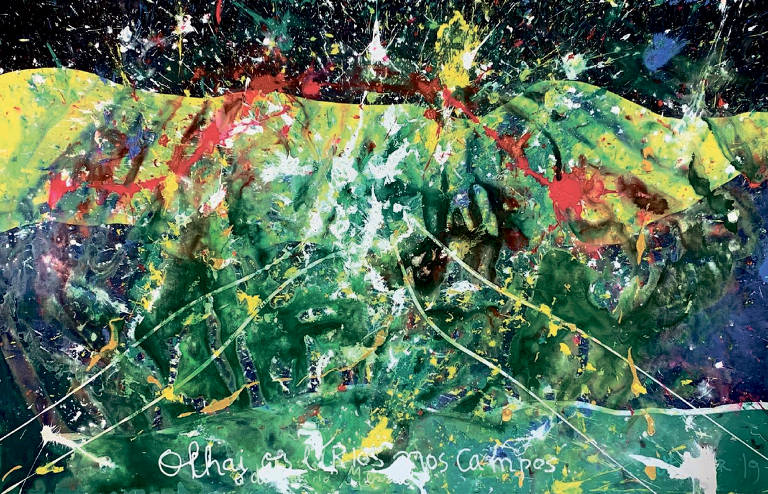
And Aguilar answered right away that he was in, he told me, "_Buy some stained-glass paint, buy the colors you're going to paint with, let's make these paintings together._" So it was incredible, because we extended the workspace across his studio. And Aguilar's studio is big, rectangular, like a shoebox really. We unrolled the reel — it was 10 minutes total running time — and we went cutting each section and laying out what was almost like a canvas on the floor. And from there, myself, Aguilar, Sérgio Villafranca (who was with us assisting with the painting), and Rodrigo Gava too, if I remember right, we walked around throwing paint, walking and throwing paint.
And that was a learning process in itself. I gradually learned from Aguilar how I could be guided by the paints, how I could see what the paints wanted, where they would take me. In that process, the paints seemed to lead me to unprecedented places. And Aguilar, since he'd inherited a film club from his father, knew a lot about handling film stock, so he could cut everything easily. And at the end of the process we wrapped it up in little packets of butcher paper, in small rolls that we kept in a styrofoam box, which I took home with me.
And then when the drive to organize this exhibition at MAM came up, I told Ruy Gardnier about this film and he was thrilled to bring it to Rio. And that's how this miracle of being able to screen this film happened. And the room was packed, you know? There was a charged atmosphere. And the feeling of watching this film is like stepping into a time machine, a telepathic conversation with Agrippino. It was a very powerful screening, I was enchanted. And that's why the film got that name — it was a tribute to everything Agrippino protected in us.
And I learned from Aguilar... Aguilar often writes names for his paintings, and he told me something I find fascinating. He told me: "Ah, I make literature, not painting!" So there are always these "Aguilarian" inventions. But I understand him, because he paints and sometimes also names the work, he creates a title, a specific phrase that transforms the relationship with the image, and the image in turn transforms the phrase. When we named this film _Agripino_, Agripino made a telepathic communication with us. And this film is a conversation with Agripino.
And I think he's still in process — we found material from an unreleased interview with Agripino, and the sound in this film turned out incredible! Because it was sound material at 16 frames per second, so it sounds almost like voices from... from what Deleuze talks about, right? From Chaos, from a plane of chaos. So it's the creation of that plane — if you go in headfirst, you can be devoured, if you're not ready. But if you let the forces of chaos sprout, they flow and connect with the chaos. He talks about this in the book _What Is Philosophy?_, as a concept for creating an ethics.
And that ethics would be precisely to allow the forces, the movements, the weaknesses of chaos to be born spontaneously, by themselves. And for us to let that plane happen. For instance, Deleuze talks about the plane of composition, the plane of immanence, the plane of consistency, and this plane of chaos, and a plane of the image. And I consider that this film, this transparent film strip, this transparent membrane, is a plane of composition for Agripino to sprout from. And that's how it was born, from that process.
So, one last question — what was it like for you, the public's reception of this exhibition in Rio de Janeiro? What was it like seeing the audience react to the films and the performances? And for you, how did you feel watching the screenings?
I thought it was wonderful, first because it's the first time his video work has been shown in an exhibition, and I loved that there were people of all ages, young kids and young people, really great people, alongside older people who were friends of Aguilar's. So it's really great because some of Aguilar's films are more provocative, especially in relation to time, to duration, to the portraits he made of people, the way he uses the camera... it's a camera that doesn't film, you know? It's a camera that navigates and dives. It's a plunge.
So it was three wonderful days, I think over those three days a kind of familiarity ended up forming, even a family of friendships, because you find a space of shared experience. And it's also a luxury to be close to Aguilar, who's turning 83. It was a celebration, a big celebration. And it was really great to bring my friends from São Paulo along for this venture, to create this membrane of connections, and to be able to occupy the MAM Cinemateca, which is such a culturally powerful space — that room has an absurd energy, a strong, hot energy.
You can feel Hélio's ghost spinning around, Glauber's ghost filming Di Cavalcanti. And it's a place where countless films have been projected onto that screen, right? I believe that every time a film is projected, something of it stays on the screen after the projection ends, so in a way a kind of spectral cinematic palimpsest gets generated there. And that room is incredible, it feels like a 1950s airport, and those chairs make a noise, so the screening turns almost John Cage-ian. And it sways, so it's a chair and a hammock at the same time. Anyway, it was a big celebration. And I got to do it all while staying right next to Clara Choveaux's place, who is my love, on top of bringing Sérgio Vilafranca and Henri Daio here to Rio... What was the other question you asked?
I don't think there was another one, but a thought just occurred to me: how did Aguilar himself react to the screenings and performances? I loved that I got to take part live in one of them, almost like an interviewer on stage, with Sérgio Vilafranca and Henri putting together the soundtrack too.
Look, he was over the moon! He reacted like it was a party. I remember an unforgettable moment when he said he saw Dante Alighieri in the audience, and he said it out loud, facing the crowd. So it was a transmission of intensities. It's not enough to put on an Aguilar event with just a screening, because his figure demands a performative, collaborative act with the other. The movie theater needed to stop being "just" a theater. It needed to almost become a child's room, a playroom. Or a room for children.
And I really loved your part in it, Francisco, because that day we were trying to get Aguilar even more stirred up, to ask him more questions, and I remembered you and called you up to the stage. To perform a question, on stage. And you went up, sat in a lotus position (almost meditative), and asked your question. And you asked a great question, about intuition! And intuition is the great, permanent question running through Aguilar's whole trajectory.
It was a question I asked because I became really fascinated with this idea of the unconscious, of the act of intuitive creation in painting, almost as if the painting were guiding itself — I find that incredible.
Exactly, that's the idea of projection!
Projection, yes.
If an artist like Aguilar taught us that what leads and guides him is the paint, that he obeys the paths of the paint, I think the equivalent for us in the field of cinema would be light. We dance to the movement of light.