Interview with Bruno Pires and João Pedro Faro on Infinito Ábaco
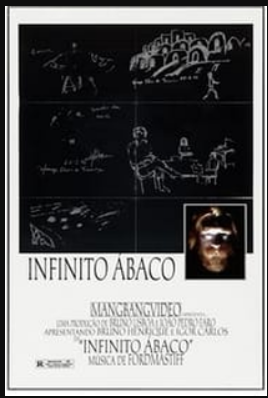
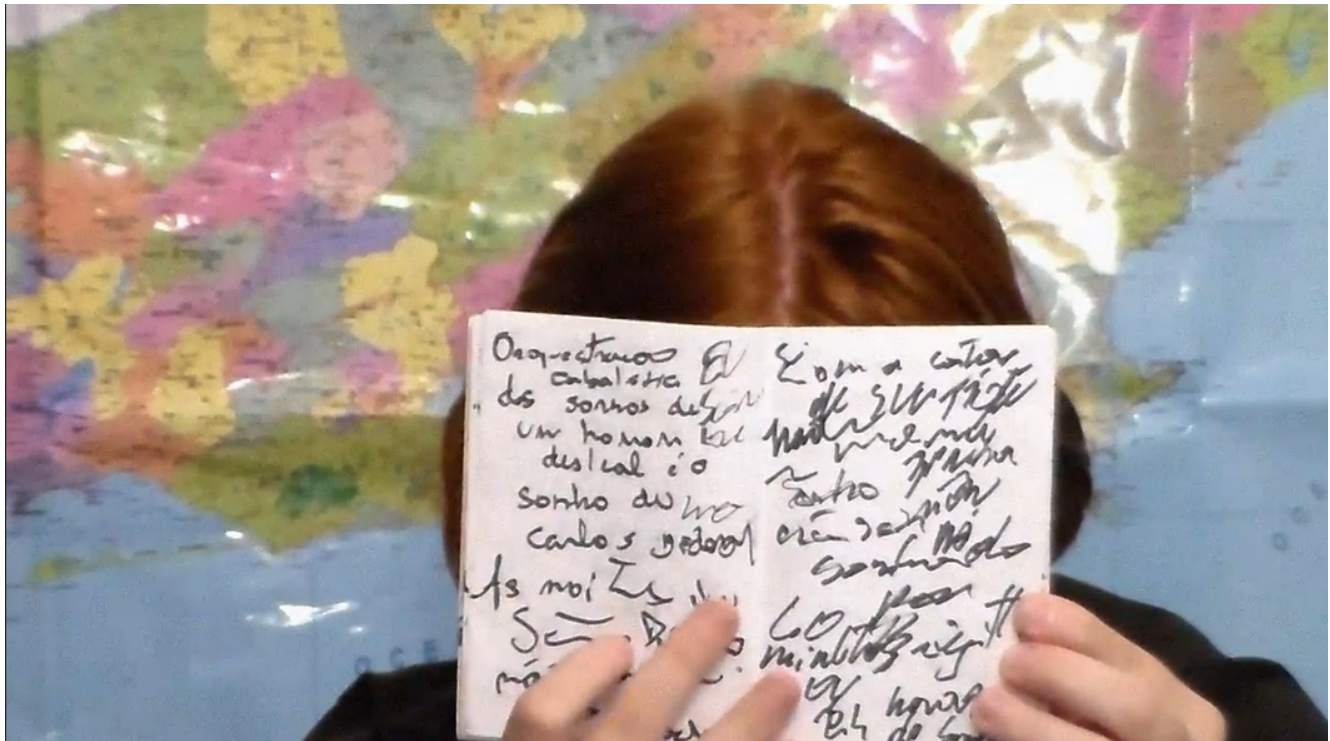
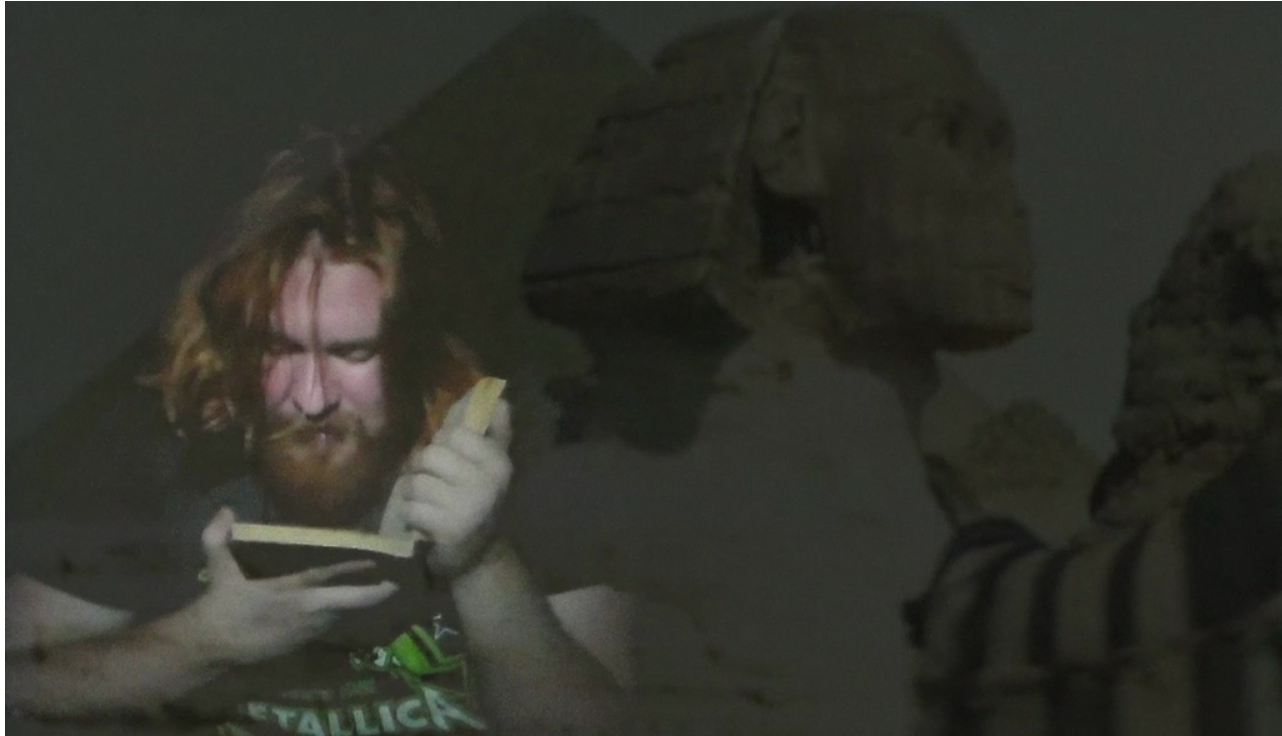
How did _Infinito Ábaco_ (_Infinite Abacus_) come about? What was the process of conceiving the idea, from concept to shoot?
Well, the film is in dialogue with a short I'd made a few years earlier, a five-minute video, sort of in a _found footage_ style, about aliens and conspiracy theories, a short I found really fun to make. So I decided to expand a bit on that stylistic line in _Infinito Ábaco_, which isn't a found-footage film, but that was the initial spark, and it ended up becoming a funnier film, a character film, you know? It became a mockumentary about this character, played by me, filming himself.
Right, I think the overall concept of the film came from a merging of old interests and particular obsessions of ours at the time we were developing it — we were watching a lot of Jean-Claude Rousseau and Luc Moullet films back then, and our idea was to try making a comedy feature that would be structured formally, and built out of a really extensive body of text, of the character's dialogue.
Yes, because the films we'd made before, _Sombra_ (2021) and _Extremo Ocidente_ (2022), barely had any dialogue, and when they did it was made up of narration. So _Infinito Ábaco_ is the first one of ours that has these long monologues.
The idea was also to jump from films that had almost a "wordiness," or that dealt a lot with the idea of the recorded word, to making a feature that would basically be carried by some kind of verbosity. A didactic comedy. And that also has to do with how it was made, being a science-fiction documentary. So it basically sets out to experiment with genres and ideas until something concise and its own takes shape, something that isn't really any of its original references. Basically that was the process for this film, and for most of the films we've made so far.
I think that's true of any film we've made so far, we pull together various themes, various ideas, and the final result ends up being something completely different from the starting point. And this film, besides being science fiction and a documentary, is also a comedy, right? When I sat down to write the monologues I realized not only that things made a lot of sense together, but that it had become a really funny piece of writing — it's about a character who's barely aware of how funny he is. And I think watching this film can be a bit tricky, maybe, because you don't know whether to take what he's saying seriously or not.
This question of genre is really fascinating, because one thing I noticed about your production company _mbvideo_'s films is that all your features deal with some specific cinematic genre: you have the buddy-film-ish genre of _Sombra_ (2021), the war-film genre in _Extremo Ocidente_ (2022), and here, besides science fiction and the mockumentary, you have comedy. So I wanted to ask: does the genre come first, before the idea of the narrative itself? How do you see this question of genre cinema?
I think the idea of genre is born first, but it doesn't necessarily stay fixed all the way through the film's development.
Genre is the set of cinematic conventions that make sense to work with, given a certain idea. So I think, for me, maybe it comes later, because what comes first is never necessarily a drive toward a feature, or toward a specific genre — it's a set of ideas and interests of our own that we end up recognizing within a web of other references. And all of that leads you to conventions, to working with existing conventions. And that's not necessarily an unavoidable element, but it's always welcome, especially in these projects where the central idea is this constant, never-finished attempt to find a balance, a mixture, or a link between more intense aesthetic experiments and more recognizable narratives, with recognizable traces of other cinemas, cultural products, artistic media, and more or less erudite, more or less intelligent, ways of thinking.
So it's always this attempt to homogenize things, and genre is a convention, genre is when you notice some element that unites a given group of things. So in a way, when we're interested in making films that have some kind of recognizable element, it's hard to escape genres, because they're what determine the conventions. So that's always something that interests me, genres and archetypes. In the case of _Infinito Ábaco_, it doesn't really deal that much with archetype, or even with genre as such, but it does deal with this idea of breaking expectations, especially within a comedy, of breaking what you expect or don't expect to happen within a given structural and logical sequence of the film, which explains itself as it happens — so what's left are these altered perceptions of conventions and archetypes.
On this question of comedy, I wanted you to talk about the film's humor, because another element in _mbvideo_'s films is this idea of exploring something extreme, even in the sense of a certain violence that produces a certain strangeness, a certain break from what you expect while watching. And I also wanted you to comment on the question of irony, because the idea of irony is sometimes viewed with suspicion — do you think all of _mbvideo_'s work involves a question of humor?
I think there are certain kinds of violence that are acceptable, depending on the setting you're in, right? So, for instance, we submitted this film to film festivals like Festival Ecrã, Festival de Tiradentes, which are used to this kind of more experimental, low-budget film, one that has a certain violence to it. But at the same time, I'm not talking about physical violence, right? It's more about the things that shock — I think humor is a kind of violence...
Humor is always cruel, right?
Right, I think a certain kind of violence is accepted, even expected, at these festivals, certain themes are expected too. And I think making a film like... I don't know, I think comedy is a genre that gets little recognition, especially when it's made this way, on a low budget...
And it's one of the hardest genres to pull off, right? Because you have to find a way to be funny consistently, and that's not really easy — not that we manage it, but the attempt to create some comedic element is always there, always constant, despite the intense seriousness you find in all our projects. Even though we're two people who take ourselves very seriously.
Making comedy is a very, very serious craft.
Very! And it's a commitment.
It's really hard to make comedy in general, but I think... I don't think the film is ironic. I think it has a character who's quite "real," but more real than certain people watching the film might believe. Of course the film has jokes, right? Because it's a character living inside an illusion...
He's socially displaced.
Right, socially displaced. But I think the film should be taken seriously as a comedy, I don't know if that's a paradox, this idea of having to take a comedy seriously — depending on where this film screens, I think people might find that ridiculous, might find it corny. Because at the same time that it has references to Rousseau, to Moullet... and Luc Moullet himself is already a completely humor-driven filmmaker, right? He has bits of clowning in his cinema worthy of the Farrelly Brothers, but he's already a more "canonical" figure, anyway.
But while the film brings in these somewhat more erudite or "underground" references, it also has the freedom to deal with topics that are popular, whether from television or the internet. I think maybe its actual starting point was YouTube horror videos, you know, those horror series you find on YouTube, like _Marble Hornets_, which everyone knows today but was a horror series shot for YouTube between around 2009 and 2012. That was a huge reference for us too, and I think it deserves to be taken seriously as well.
I wanted to ask about your trajectory, because at this point you officially have four features (with a fifth already shot and about to come out), and I also wanted to ask João, as one of the founders and lead directors of _mbvideo_, whether he feels there's been an evolving line from project to project, and whether his process of making films has changed radically since finishing _Sombra_ (2021) — what has that been like for you both?
I think what matters in each project is going a bit against the grain of the previous one, and that's a natural movement, a common one that I think happens with anyone who produces any kind of work. But what stays constant across our experiences is an attempt to keep constantly creating new obstacles for ourselves, so sometimes it's hard to see the evolution from one film to the next, because the problems that come up end up being new, unprecedented. So the search for a new problem, a new obstacle, is always the main engine.
And these projects keep getting more ambitious, whether we like it or not, except when there's a more radical shift, like in the case of _Infinito Ábaco_, which is a more ambitious film with a smaller budget, smaller in scale compared to _Extremo Ocidente_ and _Sombra_.
And it was made over months.
Right, it was shot over a few weeks but developed over months. So we keep getting more ambitious, dreaming bigger and bigger. But the budget question doesn't improve, it stays low, but the sacrifices keep getting bigger: more actors, more extreme situations...
Ambition and malice. The factors that define our films are ambition and malice.
And whether we like it or not, in this process you end up gaining a certain confidence, you learn to get a bit cocky too, right?
Not that we're rewarded with any confidence, but really the goal is always to be more ambitious and more malicious. And I think malice, in general, is also an affective question, you know? Malice isn't cruelty, it's different. It requires both aggression and subtlety too — knowing the moment you can be malicious, knowing how you're going to be malicious, how you're going to dodge and hit the common places, all of that has to do with malice. And I think those are always our great, main intentions: malice and ambition. To me, these two elements aren't just about creativity and invention, but also about a passion and a love for reaction, a love for the feelings and perceptions that can be produced within cinema, and really within any kind of artistic expression.
My last question is about how you both feel showing the film at a festival, and how you see yourselves within a tradition of a certain independent experimental cinema — do you feel part of some modern tradition of Brazilian experimental film?
Look, speaking not just of experimental cinema but of Brazilian cinema in general today, I don't feel part of anything. Obviously there's a ton of filmmakers I like and admire a great deal, and who I'm friends with too, but I don't think there's much unity to it. And screening a film at a festival, however great the festival itself might be, is always kind of a bummer, because it's always frustrating, because you always hope the film gets an extreme reaction, whether negative or positive...
And in the end we get something lukewarm, right?
Yes, we get the lukewarm. But I think we're in a somewhat turbulent period these last three years, when it comes to film festivals and obviously film production too. We're weak for obvious reasons. So I can see that festivals are recovering now, right? I think the Mostra Filme Livre hadn't happened in person since 2019. And it's kind of a catch-all, right? It's showing films from various filmmakers, various places, so there isn't a very specific niche to fit into. So I don't know, I think there is even a certain South American Brazilian experimental film scene, except I'm not part of it. And I think even the best of them aren't really part of it either.
You can't really find that anymore... we don't live in the 20th century anymore, so those ideals of movement, of cohesion, don't exist anymore today. We now live in a radical individualism, right? Everyone for themselves, and none for all, so it's kind of a racket, right? It's a personal alliance between people you trust and who trust the work of making your film, and eventually the film might screen, might not screen, and these things are also social variables. So it's always a question of testing the limits of the sociability standards of the cultural scene and the kinds of curatorial models that exist today, which are insufficient and shallow. So what matters is always finding a way to fit in around the edges, and in a way that's sometimes more deeply intuitive than strategic.