20th Mostra Filme Livre Coverage: Interview with Gregorio Gananian, director of Nenhuma Fantasia (No Fool) and G.M - 8 Cantos

_
_
Interview conducted at Estação Net Botafogo, on September 15, 2023.
How long have you known Negro Leo? How did the collaboration and the idea for this film come about?
Leo and I have known each other since around 2012, 2013, when he did his first show in São Paulo I was in charge of the set design, so we've known each other about 10 years. And during the pandemic he was invited to take part in the _Festival Novas Frequências_ (an experimental music festival based in Rio de Janeiro), and as part of that invitation every artist taking part also had to develop a visual work, and so as soon as Leo got the invitation he called me and asked me to take part, we sat down and started thinking things through, developing ideas, and at the end of that process we shot the whole short film inside my house, over the course of one day.
I wanted to ask about two elements that are very important in the film: the element of technology and the question of humor. Because there's an open dialogue about social media, about Google, and also about robotization, the use of robots (with the Boston Dynamics footage appearing), and the short also has a very distinct sense of humor — what was it like creating this language, this combination of the two elements?
Well, in our conception of humor we call it "rumor," "rumorism," because our intention was to work with a kind of cinema tied to a question of rhythm, of speed, that's somewhat in dialogue with the cinema made in the '40s and '50s, and Brazilian cinema of that period specifically, like the films of Rogério Sganzerla and Andrea Tonacci. And the idea of "rumorism" is precisely about these sounds, these rumors, these kinds of sonic propagations that drift around us and create a resonance — these kinds of sounds, their speed, along with the speed of that kind of cinema, served as an index that guided our path. It was also very important to think about the question of speed, we were interested in rethinking that idea of standardized speech used throughout the 20th century, and we also drew influence from other places, from music, even from cartoons.
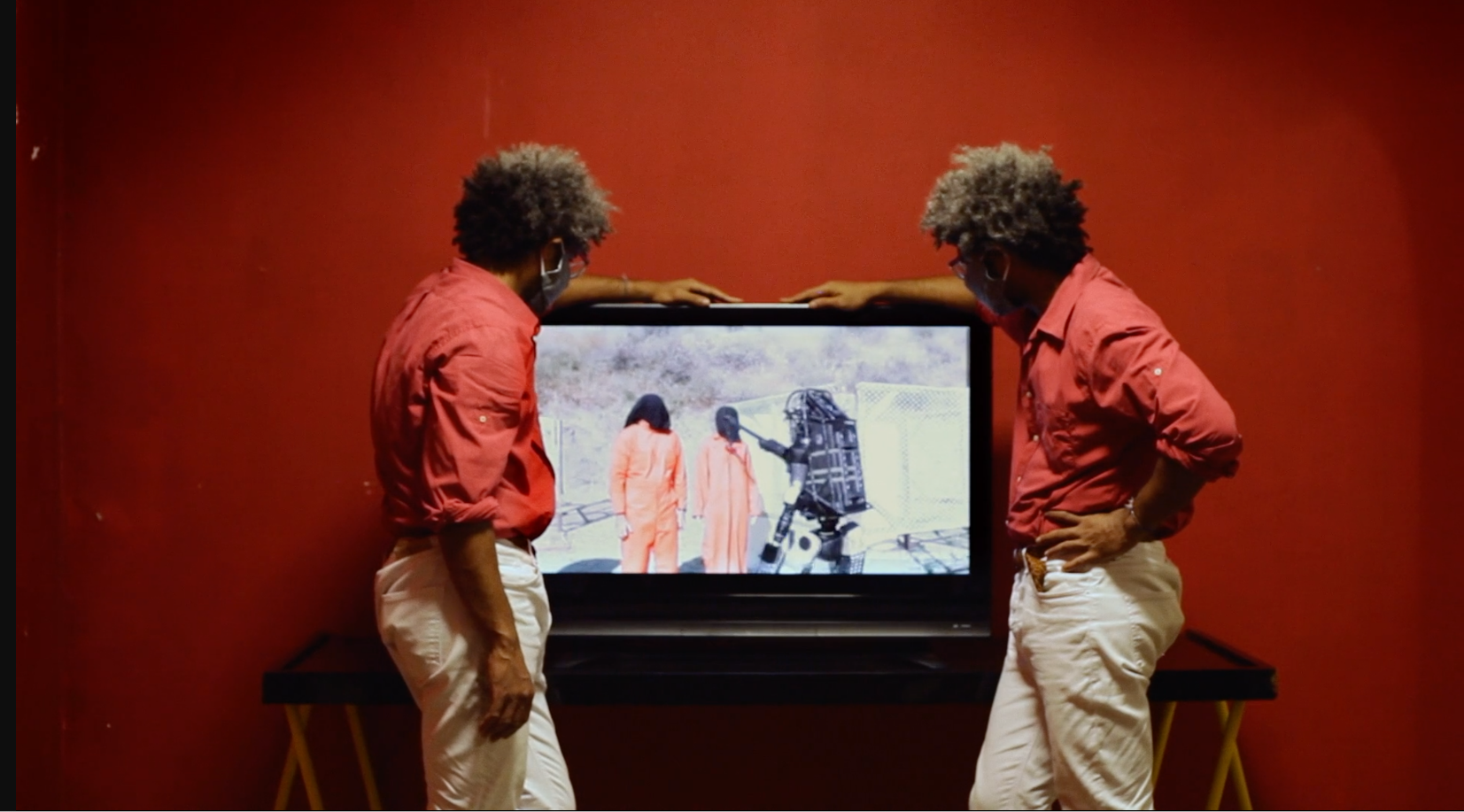
And on the question of robots, that Boston Dynamics footage (the American company that makes robots tested for police and defense use) came up right during filming — we were shooting and suddenly I remembered one of the videos I'd watched on YouTube, and I thought it was incredible, because I remember Leo and I both thought there's going to come a moment when these robots enter a real war, you know, with humanity, so we put it in the short almost to say we're on the robots' side! That when the time comes for them to attack everyone, don't attack us! We're with you! In other words, we understand their pain, we understand the fight that's coming.
**
**
It's fascinating to see how you explore the idea of _mise en abyme_ in the film, with several "Negro Leos" present — first him talking to himself, and then with his figure duplicated to infinity on the television — how did that idea come about?
It was Ava Rocha who came up with that idea! It was Ava who asked Leo, "_Why don't you make a film of yourself inside the television?_" That was the idea, which is a really interesting one, of making a film starting from the lowest common denominator, right? With a character repeated infinitely on a television screen, duplicated in space — so that original idea came from Ava.
In your introduction to the film at the Mostra Filme Livre, you said that you and Negro Leo wanted to make an "entertainment" film, and I think one of the striking things about the work is the sheer intensity of it, that frenetic rhythm that creates a sense of variation from shot to shot, and I wanted to ask about this idea of entertainment itself — how do you see this concept within this short and within your filmmaking as a whole?
I think this question of entertainment... Eisenstein talked about the concept of the Cinema of Attractions, the attraction you find going to an amusement park, going to a vaudeville theater, with the dancers, the jugglers, and so on — I think this film of ours is a bit of a return to that idea of attractions, an idea of recalling the style of that kind of cinema that's in dialogue with the circus, with that public space of attractions, that idea of entertainment. And, at the same time, the film is very singular, right? Because in the end its narrative ends up recalling... do you remember that film _Don't Look Up_ (directed by Adam McKay)?
Yes, the one that came out on Netflix in 2021, about the end of the world.
Right, and that film ends with the guy who owns a billion-dollar company, a kind of Elon Musk figure, arriving alone on an alien planet, and our film ended up having the same ending! Here, our Elon Musk ends up on the Moon, sad that planet Earth has come to an end. So our film is an attempt to make genre cinema, because we were trying to work with comedic cinema, that influence of the Howard Hawks films he made in the '30s and '40s, _Bringing Up Baby_ (1938), _His Girl Friday_ (1939) — the speed you find in that kind of cinema is incredible, and it's a speed Rogério Sganzerla was very much in dialogue with, because he understood that style and brought it to us, right? He always wrote about American cinema, about Hawks, about Samuel Fuller...
On the question of technology, within the film's own dialogue there's a mention of Google, and this question of the modern use of robots, and I don't think the film takes a clear thesis, but I keep wondering whether its view is more skeptical about the way this technology is being conventionally used — do you think the film's outlook, on the present and future of this technological question, leans more skeptical and negative?
Well, I think something a bit negative does happen in the film, because it ends with Elon Musk on the moon, sad that Earth is gone, so it's a bit catastrophic in that sense, but there's a certain irony to that catastrophe too, right? And the English subtitles are surrounded by text drawn from the Book of Revelation, so there's that weight to it, except that, to my mind, it also represents a somewhat idiotic ending that finishes off humanity. And that resonates with me from my point of view — Leo might see it differently, I'm speaking for myself here, Leo doesn't necessarily think the same way, I think each of us imagines something a bit different.
And I remember a time when I was with Sérgio Villafrança, a composer and pianist I'm very close to and work with a lot, and we went to visit Augusto de Campos's house — he's a figure who historically always made a certain... I won't say an empty case, but he always defended the use of technology, arguing that poets need to build a relationship with existing media, it's basically the Marshall McLuhan path, of media and communication as an extension of man.
And I found our visit to his house really interesting, he's 96 now, and in that meeting, for the first time, he made a critique of technology. He said he thought technology was moving too fast, in such an accelerated way that it makes everything excessively ephemeral. If you develop a language through one medium, the next day it's already being cut short to make way for a completely different medium. And I found his observation really interesting, because I'd had a certain passion for the ways technology could be used, and that path of Augusto de Campos, of Marshall McLuhan, of communication theory, had personally influenced me a great deal.
I think technology is always going to be part of our lives, we write, speak, walk, and record using technology, but even so it's always a struggle, right? It's always a daily battle, a dispute, a dispute that historically seems to be trending toward losing, right? But that's part of a win-lose process. I mean... I'm from a generation that dreamed about the internet back in that luminous moment in the early 2000s, when everyone downloaded films, there was this spread of culture, an idea of a renaissance the internet would bring — and it did bring that, on one side, right?
Nowadays there's a widespread complaint and criticism of social media, and, at the same time, I also see a lot of good people emerging precisely because of social media, a lot of people who wouldn't have had space otherwise — I mean, people are sometimes very nostalgic for the era of record labels, and to me that's absurd. Do you know how many independent artists' records were released back then? Very few! I mean... who's nostalgic for that? Nowadays, at least, an artist on social media can reach an audience of 20, 100, or even 1,000 people, right? But technology today has already become something else, it's no longer a matter of choosing whether it works or not, it's _tékhne_ itself, right? I think the concept of technoshamanism is a really interesting path for understanding our relationship with technology today.
I also wanted to ask about the other film you're showing at the Mostra Filme Livre, about Gilberto Mendes, called _G.M. - 8 Cantos_. You directed it and Sérgio Villafranca was responsible for the score, and I also wanted you to talk a bit about your artistic partnership with Sérgio.
**
**
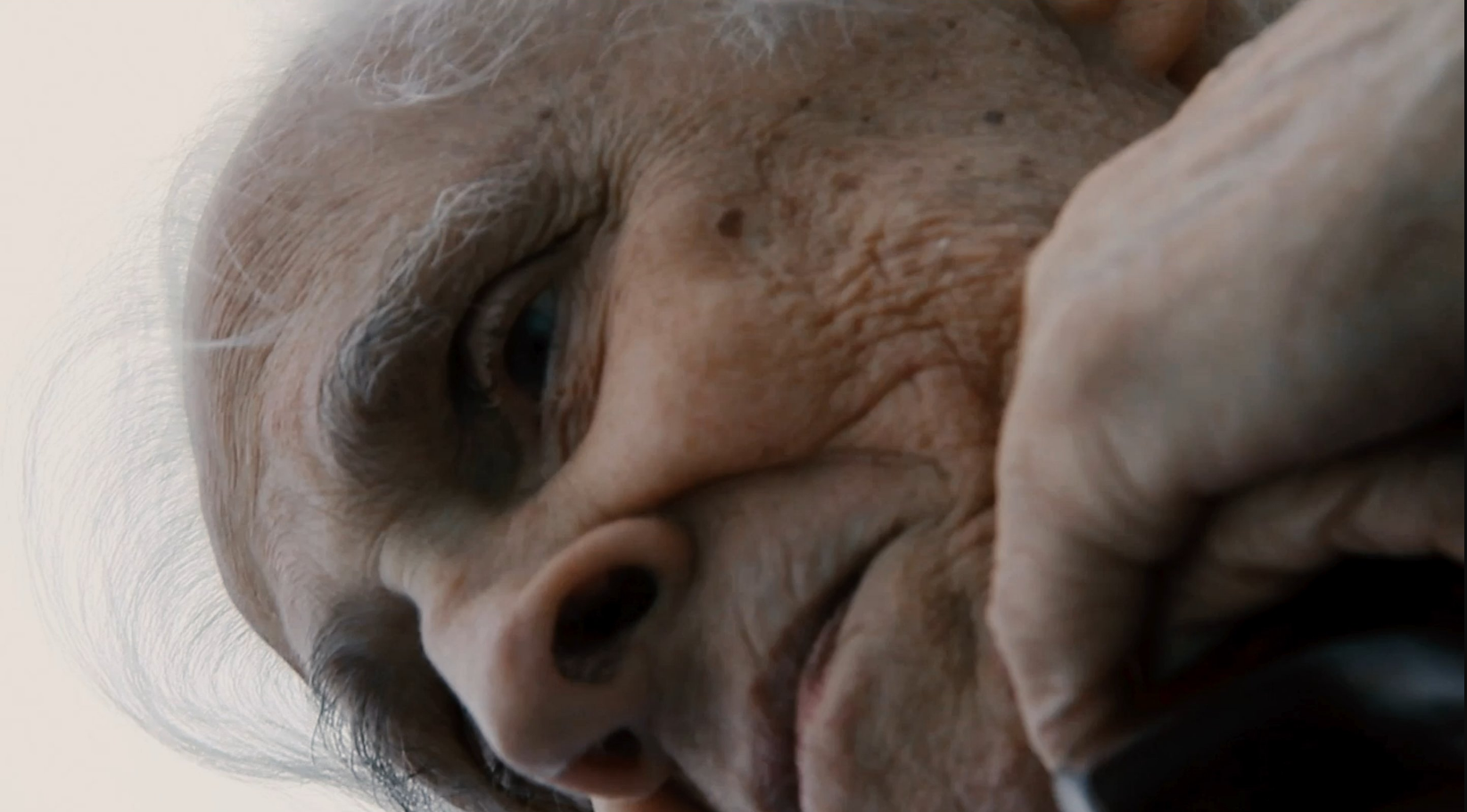
This film is very beautiful, it's almost an album of memories. It's a film that fills my heart with joy and, at the same time, a feeling of nostalgia, because I met Sérgio when I conceived and directed an operetta with Gilberto Mendes, the great Brazilian composer and conductor, who passed away at 93 in 2016. I personally forged a friendship with him, a relationship with Gilberto that lasted from when he was 89 until he was 93. And it was through that show, that operetta called "_Gilberto Mundos_," that I met Sérgio for the first time.
And Sérgio is a great partner on several films, we have a lot in common, we develop many projects together. We have a partnership that's almost like an artistic creation company, and it was during that same period that he met Negro Leo, whom he recently collaborated with on a show in São Paulo, so everything is connected. And during the pandemic there was going to be a tribute to Gilberto Mendes in the city of Santos, because he had passed away, and the curator of that tribute, Márcio Barreto, called me asking if I had any memory, any filmed fragment of Gilberto, because I used to visit him regularly, I think I traveled to Santos about 15 times to see him. Gilberto had appeared in my feature film _Inaudito_ (2021), but his sequence hadn't made it into the final cut.
So _G.M. - 8 Cantos_ is built out of these fragments of affective memory. When Márcio called me at the time, I started digging up the footage I'd shot of our meetings with him, and it was simple footage, from a phone, of everyday moments, and in most of it Gilberto was singing — he loved to sing, and I was always filming him singing. So the "cantos" ("songs") in the title are Gilberto Mendes's songs, and they're songs of friendship, memories of different moments, the film is an album of memories.
When you watch it you'll feel that, it's a film I consider a "minor" film. Minor in the best sense, in the sense that Deleuze and Guattari talk about a minor art. And it's a film pitched at a different voltage than _Nenhuma Fantasia_. I'm a filmmaker interested in exploring both frequencies of cinema: the high-speed one of _Nenhuma Fantasia_, and this more Tai Chi Chuan kind of cinema that _G.M. - 8 Cantos_ represents. And today we're feeling really happy because Sérgio composed the film's score and is going to play right after the screening ends, and being able to come here to Rio de Janeiro, after the pandemic period, carries a lot of symbolic, affective memories, being able to return to this web of encounters and resonances.
And Sérgio is a kind of disciple (maybe that's not the best word) of Koellreutter, the great Brazilian composer who taught in Bahia — taught Tom Zé, Caetano Veloso, he was the one who founded Bahia's music school. And Gilberto Mendes had written a piece called "_Meu Amigo Koellreutter_" ("My Friend Koellreutter"), and that's the piece Sérgio plays in the film, and that's what he'll be playing in the theater once the screening ends. So we're in this atmosphere of hugs, a more festive mood, celebrating life, right? Always with a bit of heartache for everyone who's passed. Especially for the people who were part of the Mostra Filme Livre and who were honored at the opening session.
The last question I want to ask is about the Mostra Filme Livre itself — what's your relationship with this festival? How do you see its importance for independent Brazilian cinema?
This festival holds a special place for me, it's more than 20 years old and has always been a kind of radar, a place that shows a kind of cinema that seeks truth, with that quality of amateur cinema, of home-movie cinema, and there are a lot of great people at this festival, you know? So I feel a real happiness that it's still alive, I think it's a miracle for an independent film festival in Brazil to be more than 20 years old. And my last feature film screened at the festival, in 2019. And, well, I think this festival performs a miracle, and before long it's going to understand the miracle it performs and will keep performing... you know that path of the saint who performs a miracle to bring about their own birth? I think it's now going to perform that miracle of perpetuating itself, of resonating — it's a festival that's going to stay alive in our hands as time goes on.