A Couch in New York (1996) — Chantal Akerman Retrospective at MAM, March 2023
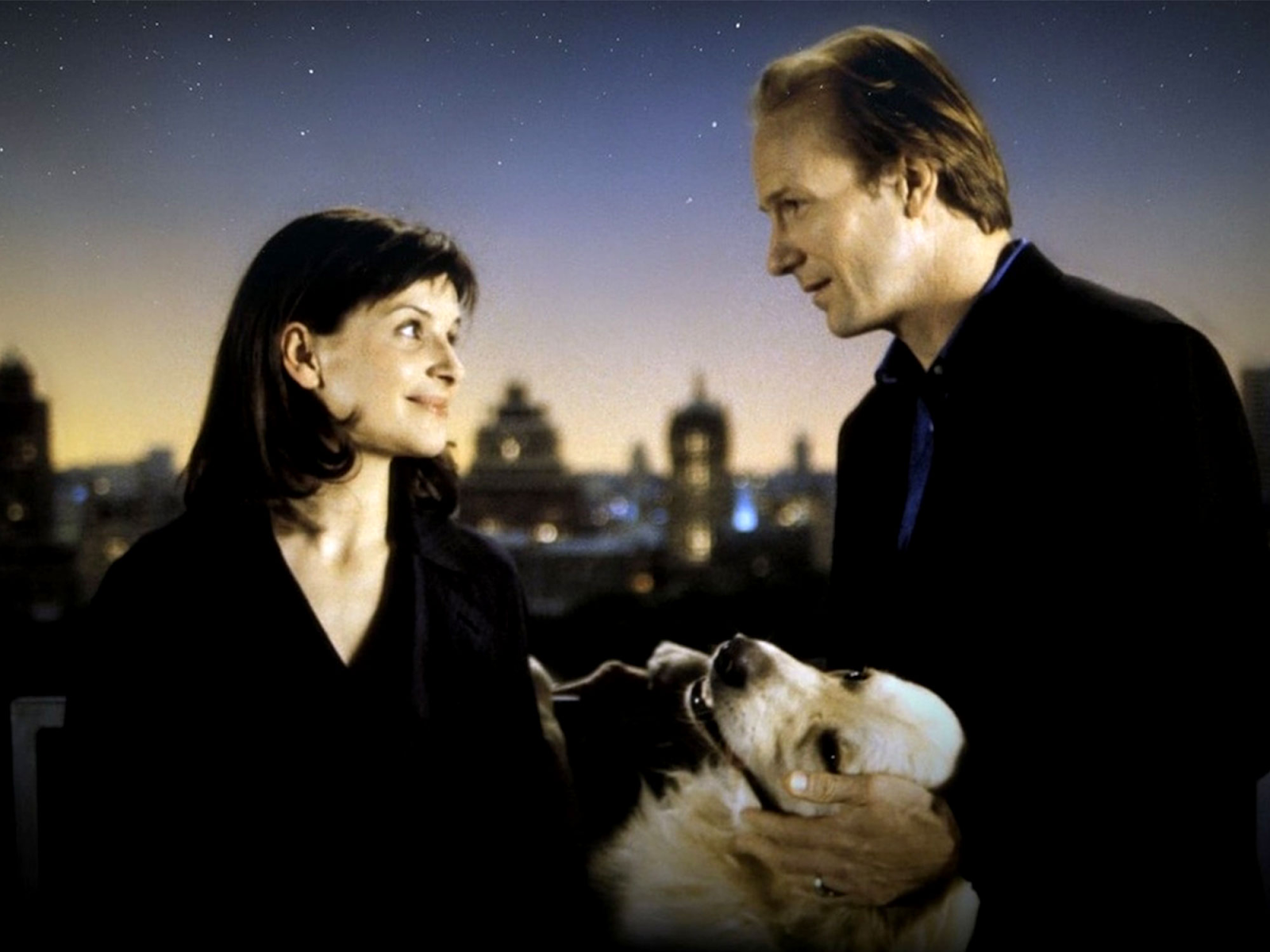
A romantic comedy in a Nora Ephron style isn't the first thing we associate with Akerman's cinema, but one thing that struck me was how she draws on elements of slapstick comedy and screwball comedy that could be found in the work of Lubitsch and Hawks, with a narrative in which the characters' estrangement from their setting's otherness ends up recalling a beautiful title from a 2015 documentary about the filmmaker: "I Don't Belong Anywhere."
Because the film's main comedic thrust is precisely the way Juliette Binoche's and William Hurt's characters deal with a continental, professional, and, in a way, class-based otherness. While Binoche manages to subvert, with a childlike naivety, the cold, impersonal, frigid atmosphere of the psychoanalyst's office in New York, Hurt's character finds himself in a comedy of errors of maladjustment within the domestic, homey environment of her apartment in Paris, culminating in a sequence worthy of Charlie Chaplin in which a jet of water is shot at the character after he tries to fix a pipe.
The beauty of the film lies precisely in how Binoche's sweet, childlike gaze is completely alien to the professional atmosphere a psychoanalyst's couch is supposed to have — in that sense she becomes, to my mind, an Anti-Jeanne Dielman: she lives life in a constant state of perplexed discovery and a daily inventiveness for appropriating the most prosaic, impersonal elements of everyday life (again, recalling Chaplin). And there's a Jacques Tati side too, in the way New York's modern technology collides with Paris's artisanal domesticity.
The film's romance, though it may seem odd to happen at first glance, is actually a product of this way of experiencing the world that Binoche embodies: by bringing an inventiveness of forms and a subversion of the banal into Hurt's world, she manages to rescue him from a sterilization of the unexpected and the unknown in his universe.
The whole film is anchored on this question of otherness — otherness of class, of profession, of roles (Hurt's character uses a fake name in order to act as Binoche's patient) — as a way of experiencing the life of another as a process of staging, of performance, in which this "lie" ends up leading the characters to a tactile understanding of new ways of relating to each other and to the world.
There are two rhyming scenes that struck me watching the film yesterday as part of the MAM retrospective: the scenes where William Hurt's character arrives in Paris for the first time, and the moment where he wanders through a New York neighborhood to use a public phone to call Binoche. In these scenes, we see everyday, ordinary people, who represent a social and racial cross-section of Paris and New York, functioning at once as a documentary, sociological detour through the film's cities, and also as a way of portraying the question of otherness so central to the film: William Hurt steps out of his privileged, upper-middle-class environment, and his presence becomes almost an intrusion within the open shots, in contrast with the spontaneous, lively presence of the "ordinary" people around him — this intrusion of a documentary quality into what's probably the most commercial, traditional film of Akerman's career is something remarkable.
The film might, to my eyes, seem like an odd fit within Akerman's career, incorporating more conventional models of reference and moving away from the structural, plastic experimentation of Jeanne Dielman, News From Home, and Hotel Monterey, but the way she handles the question of belonging (or the lack of it) as something in constant motion, in which contact with the other, through performance, through the otherness of subjectivities and lifestyles, is something that strikes me and moves me by engaging with something essential to the romantic-comedy genre: through the performance of living someone else's otherness, we're finally able to see ourselves as another.
Francisco Vidal is an actor and assistant director, based in Rio de Janeiro.