Brief Interview with José Roberto Aguilar
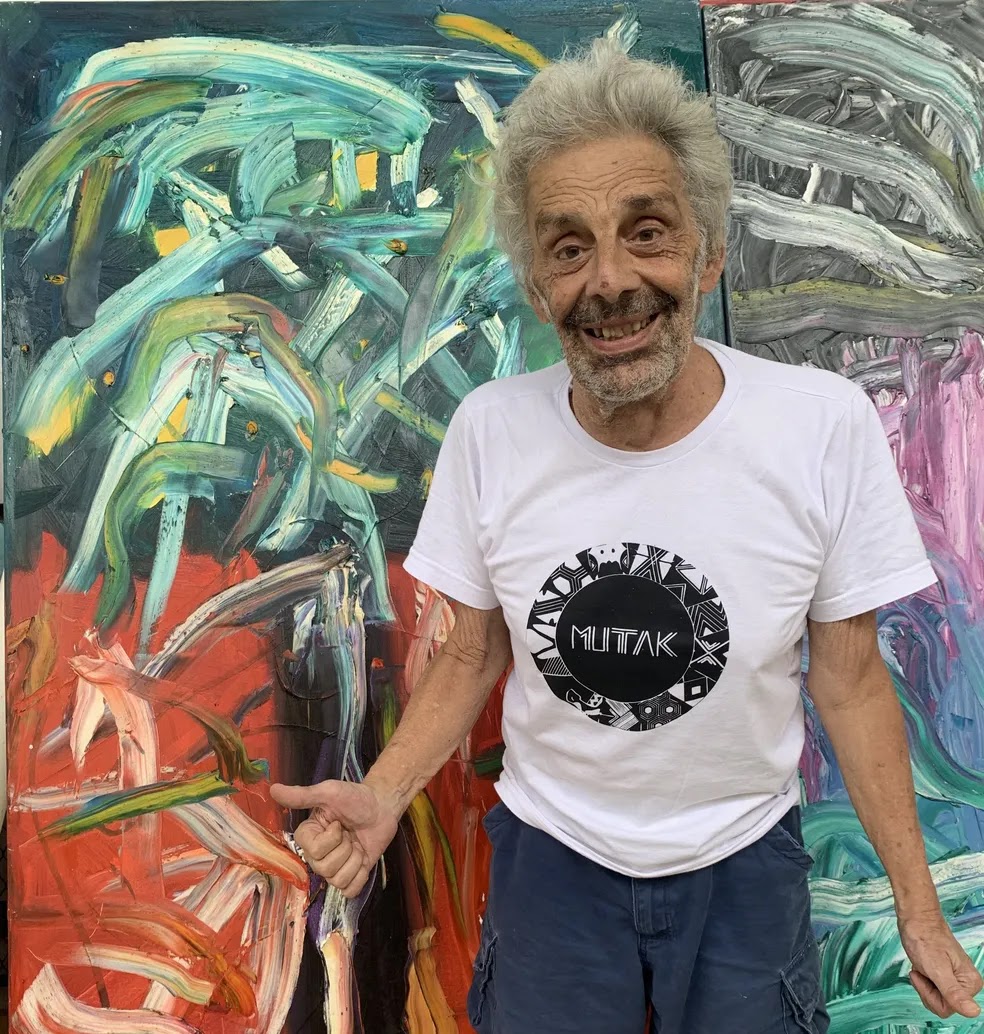
_This brief interview with José Roberto Aguilar was conducted in a hallway of the MAM Cinemateca, where a retrospective of his video work, directed and curated by filmmaker and artist Gregório Gananian — who also worked with Aguilar on Tomoaki Tomoshigue (2021) and Agripino (2023) — took place on November 16, 17, and 18, 2023.
_
Aguilar, it's a tremendous pleasure to be with you and to follow your exhibition here at the MAM Cinemateca — how does it feel seeing your work shown and received here in Rio?
Look, it's a wonderful experience. I'm in ecstasy, to be honest, because it's been a long time since I'd seen these videos. So it's as if a piece of my memory had been torn out and let loose into the air, and then came back all delighted, a memory returning. And the audience's reception here has been spectacular, because I get the impression that people in Rio de Janeiro have, unconsciously, more of a historical footing — history being something that walks alongside people, you know? Whereas in other places, like São Paulo, for instance, that kind of objectivity is more momentary. So I've been very, very impressed, and happy.
Two of your films showing at the exhibition, the shorts _A Divina Comédia Brasileira_ (_The Brazilian Divine Comedy_, 1980) and _Sonho e Contra-Sonho de Uma Cidade_ (_Dream and Counter-Dream of a City_, 1981), use two parallel screens to show completely distinct images, where the viewer has to draw some kind of association or convergence between them. What was the process of making these films like? Did you know from the start of development that they'd be shown this way?
Yes, that was already the goal before filming, the idea was always to present a duality. In _Sonho e Contra-Sonho de Uma Cidade_ there's one side that's the oneiric side, which is New York, and one side that's more Bacchic, more Dionysian, which is that car graveyard — so the presentation of these two sequences was the dream and _counter_-dream. In _A Divina Comédia Brasileira_, I wanted to use the figure of the clock to make the division. So the initial division was the idea of paradise split in two: on one side, a Brazilian paradise reflected within the Black Umbanda ceremony, which is wonderful, and on the other side a European paradise represented by the figure of the Cathedral and the passersby near it. And beyond paradise there's purgatory, and purgatory in this division is represented by speech, by opinion, by the idea of talking about everything, of staying in that _blah-blah-blah_, and at the end of the short there's hell, and in hell the voluptuousness of carnival appears, the naked women, the musical performances — so these were shorts made to show these dualities, and it turned out everything worked, you know? It came out really well.
On your artistic process — I had the pleasure of seeing an installation of yours where you paint not just the canvas but the whole surrounding environment, and it reminded me a lot of the concept of _action painting_ — what's the idea of artistic, spontaneous intuition like within your work?
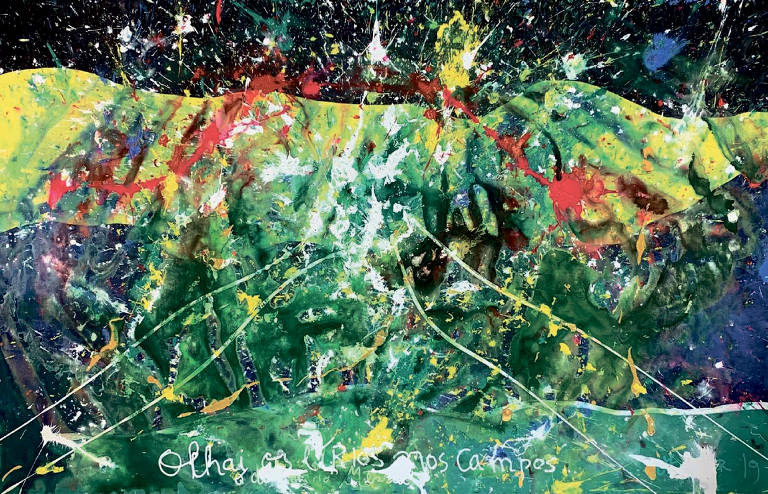
Look, for me, the association within painting — and I'll just say the obvious — is guided by the centrality of the paint. I think paint has a soul. So the more paint you use, the more gestures you find, it's a dance. And paint is also self-creating, it paints itself — you can see this in paintings where there's an amount of paint sitting underneath, but that sometimes rises up and performs a gesture of painting itself.
So there's a great convergence in my work, not just gesture without sacredness. It's a working process that only functions when you're unconsciously invaded by the singular power of paint, which possesses a soul. And all of this enters into a really interesting synchronicity of paint and body. The artwork and intuition move in the same direction. But if you're an artist who's only guided by logic, or by a diagram of events you have to obey, then the painting is going to end up very stuck. When you let go of those restrictions and become a co-author with the paints, that produces something wonderful. And that also holds true in other spheres, other languages within art.
Many of the materials you've worked with artistically come from different media, like video, 35mm film, and painting itself. I wanted to ask how you decide which material is right for a given work — is it a choice based on intuition, or on a desire to explore emerging technological processes? And, tied to that question, do you believe the modern technologies available in Brazil give artists more freedom to experiment? Do you think our generation can use new technologies inventively?
Look, this is a notion that's been present since the start of the industrial revolution. For instance, the birth of cinema was like the birth of an immense mountain giving a Superman a stumbling walk of light. It's always been like this — back in the '70s I got my first video camera, the black-and-white Sony camera, and now, 55 years later, we already have artificial intelligence. This whole question of technological evolution that we find in the past and in the present is nothing more, nothing less, than specific means we can use to make our signature, to mark our own individuality. That's the whole basis of any innovation.
Francisco Vidal is an actor and assistant director, based in Rio de Janeiro.